
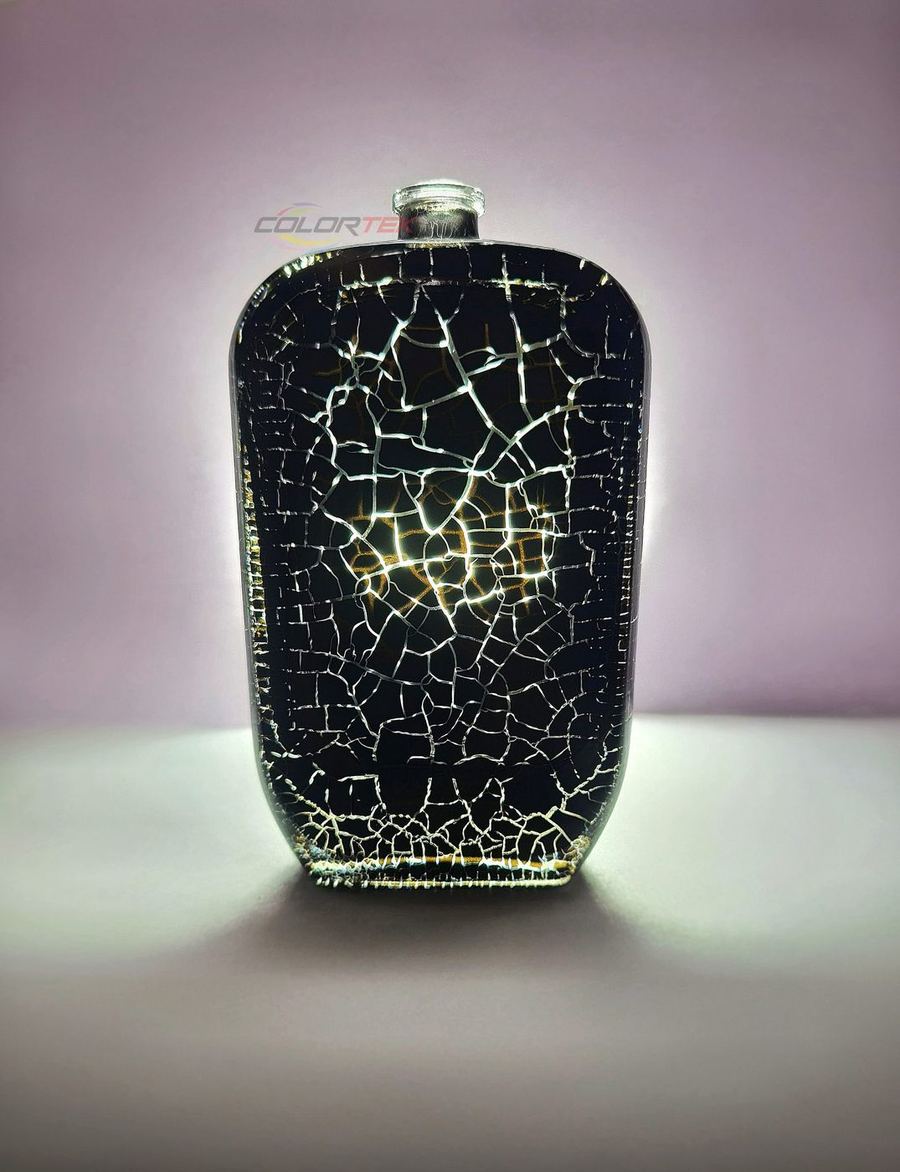
Glass gives a coating nothing to hold
Most surfaces help a coating stay put. Plastics can be flame-treated to raise surface energy; metals hold a microscopic tooth from machining; wood simply absorbs. Container glass offers none of that. Its surface is hard, smooth at the microscopic level, and chemically inert, so a coating can neither key into it mechanically nor react with it easily.
That is why a paint that performs beautifully on metal or plastic can peel off a perfume bottle in weeks. The failure usually is not the paint film itself; it is the boundary between film and glass letting go.
The three ways a glass coating fails
- Adhesion failure. The film releases from the surface, usually starting at edges or print areas. The classic cause: a chemistry that was never designed to bond to silica.
- Chemical attack. Perfume is mostly alcohol; hand creams carry oils and actives. Contents and cleaning agents work at the film every day. A coating that resists water but not alcohol will haze, soften or lift on a fragrance line.
- Mechanical wear. Filling lines, capping, transport and retail handling all abrade the surface. If the cured film is too soft, it scuffs; too brittle, it chips.
What a properly formulated system does differently
A container-glass coating has to be engineered for glass specifically, which is why Colortek's ISOTRAP exists as a dedicated one-component stoving thermoset rather than an adapted industrial paint. Three things matter most:
- Adhesion chemistry. The binder system is built to bond with the glass surface during stoving, so the finished film grips the substrate instead of merely sitting on it.
- Cure that finishes the job. Stoving cross-links the film into a dense thermoset network, which is where chemical resistance against alcohol, oils and cleaning agents comes from.
- Testing on the real thing. A datasheet number means little until the coating has been tested on your bottle, with your contents. Every Colortek batch is tested before dispatch under ISO 9001:2015.
Solvent-based or water-based, the surface rules stay the same
Whether you choose solvent-based ISOTRAP or its water-based counterpart AQUATRAP, the surface chemistry challenge is identical; the difference is the carrier, not the bond. Which one fits your line is a separate decision, and we wrote about it in what water-based coatings give you, and what they ask in return.
The failure is rarely the paint itself. It is the boundary between film and glass letting go.